
For decades, it has been the gatekeeper of our digital lives. Eight characters, then twelve. One uppercase letter, a number, a symbol — and definitely not your date of birth, 1234 or the name of your cat! But in trying to make passwords more secure, we have also managed to make them almost impossible to remember without writing them down somewhere. Especially as the number of passwords we need has continued to grow over the years. And yet, passwords remain one of the pillars of our digital security. Despite password managers and two-factor authentication, they are also one of its weak points. We forget them, reuse them, and they can be stolen. But we may finally be starting to see what comes next…
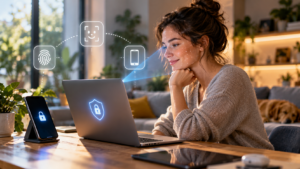
Passkeys already allow us to sign in to a service without entering a password. Access can simply be approved on a smartphone or computer using a fingerprint, facial recognition, an authentication app or the device’s PIN. Behind this simplicity lies a cryptographic system designed, among other things, to make phishing attacks much harder.
And tomorrow, authentication could become even more seamless. Trusted devices, biometrics and even certain aspects of our behaviour could gradually allow services to verify that we really are who we claim to be. Cybersecurity would then no longer rely on a secret we have to remember, but on multiple signals capable of confirming our identity.
That said, getting rid of passwords would not solve every problem. If our smartphone becomes our digital keyring, what happens when we lose it or replace it? How easily can we recover access to our accounts? And how comfortable are we with allowing biometrics or our behavioural patterns to play a role in verifying our identity? Passwords are unlikely to disappear overnight. The Internet is full of legacy systems, and our habits can sometimes be even harder to replace. But the shift is already underway. After years spent teaching us how to create better passwords, perhaps the next challenge for digital security will be teaching us how to live without them.
Ultimately, if the real breakthrough in cybersecurity were no longer having a password to protect, who would really miss it?