
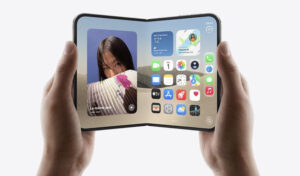
Apple is officially entering the foldable smartphone market with the iPhone Duo. Unveiled during the keynote dedicated to the new generation of iPhones, the device introduces an entirely new form factor to the lineup. The idea is to combine a relatively compact iPhone when folded with a significantly larger display when opened, supported by an interface specifically adapted to the additional screen space.
Two Displays for Two Ways to Use It
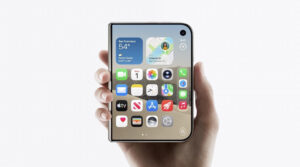
Unlike foldable smartphones that become particularly tall when closed, Apple has opted for proportions it compares to those of a passport. The iPhone Duo measures 84.1 x 117.8mm when folded and 164.6 x 117.8mm when fully opened.
The external Super Retina XDR display measures 5.4 inches, allowing the iPhone Duo to be used like a conventional smartphone for checking messages, opening an app or quickly taking a photo without having to unfold the device.
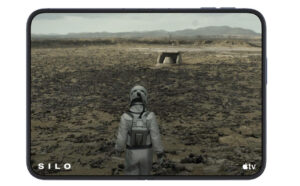
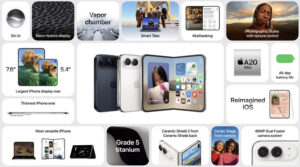
Once opened, the iPhone Duo provides access to a 7.6-inch Super Retina XDR display. Apple says it offers 50% more screen area than the iPhone 18 Pro Max and 80% more than the iPhone 18 Pro. The inner and outer displays also maintain the same proportions, making the transition between them smoother when an app is already open.
Both displays feature ProMotion technology with refresh rates of up to 120Hz, Always-On display functionality and a claimed peak outdoor brightness of 3,000 nits.
Just 5.2mm Thick When Open
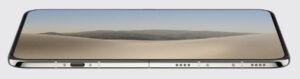
The foldable form factor naturally requires a different design from other iPhones. The iPhone Duo measures 11.3mm thick when folded, but each half is just 5.2mm thick when opened. The device weighs 254 grams.
Apple uses a Grade 5 titanium frame and has developed a hinge containing more than 100 components. A system of magnets holds the two halves together when the smartphone is closed, while the hinge cover is manufactured using a 3D-printing process.
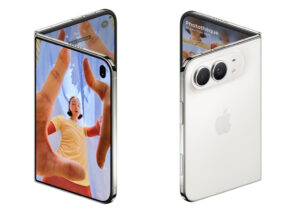
The rear of the device is protected by Ceramic Shield, while the outer display uses Ceramic Shield 2. The iPhone Duo also carries an IP68 rating for water and dust resistance.
The foldable display uses a multi-layer structure incorporating high-strength glass, a titanium plate and several adhesives that allow the different components to move slightly as the device is opened and closed. Apple also uses a matte polymer nanotexture designed to reduce reflections and make the crease less noticeable.
Touch ID Replaces Face ID
The foldable design also brings some changes to biometric authentication. The iPhone Duo does not feature Face ID. Instead, Apple has integrated Touch ID directly into the side button, allowing the sensor to be used in the same way whether the device is open or closed.
Multiple fingerprints can be registered, while Apple also retains the option to unlock the iPhone using an Apple Watch. The FaceTime camera on the inner display is positioned beneath the screen, allowing Apple to preserve an uninterrupted display surface without a visible cutout in this area.
Powered by the A20 Pro
The iPhone Duo uses the same A20 Pro chip found in the iPhone 18 Pro lineup. Built on a 2nm process, it features a six-core CPU, a seven-core GPU and two Neural Engines providing a total of 32 cores dedicated to AI-related processing.
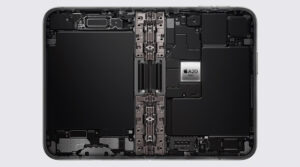
Apple claims up to 20% higher CPU performance compared with the A19 Pro, up to 40% better graphics performance and 50% more memory bandwidth. On the iPhone Duo specifically, the company also claims up to 35% better sustained performance compared with the iPhone 17 Pro.

A dedicated display engine allows the A20 Pro to manage both screens simultaneously, while a vapour chamber handles heat dissipation.
For cellular connectivity, Apple uses its C2 modem. The iPhone Duo eliminates the physical SIM card entirely and relies exclusively on eSIM in every market. Two lines can be active simultaneously, while at least eight eSIM profiles can be stored on the device.
The N1 chip adds support for Wi-Fi 7, Bluetooth 6 and Thread. The USB-C port supports USB 3 transfer speeds of up to 10Gbps, as well as DisplayPort for connecting the smartphone to an external display.
Two Batteries, One in Each Half
Apple has placed a battery in each half of the iPhone Duo. Battery life naturally varies depending on which display is being used. Apple claims up to 24 hours of use when usage is split between the two screens.
Video playback can reach up to 31 hours on the inner display and 44 hours on the outer display. For streamed video playback, Apple quotes up to 26 and 37 hours respectively.
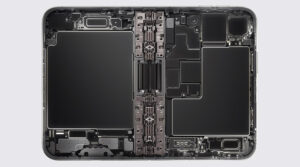
Wired charging can restore up to 50% of the battery in around 20 minutes when using a sufficiently powerful adapter. MagSafe and Qi2 are also supported at up to 25W. Apple says the battery can reach around 50% in 30 minutes using a MagSafe charger paired with a power adapter rated at 35W or higher.
Two 48-Megapixel Rear Cameras
The iPhone Duo’s rear camera system is built around two main cameras. The first is a 48-megapixel Fusion sensor paired with a 26mm-equivalent ƒ/1.6 lens. It features sensor-shift optical image stabilisation and captures 24-megapixel images by default.
A 2x option is also available directly from the main sensor, using an in-sensor crop to produce 12-megapixel images equivalent to a 52mm focal length. There is no separate telephoto camera.
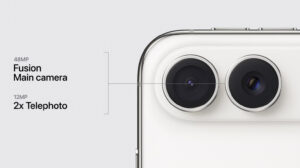
The second module is a 48-megapixel Fusion Ultra Wide camera with a 13mm-equivalent ƒ/2.2 lens. It can also be used for macro photography. Video recording reaches up to 4K Dolby Vision at 120 frames per second using the main camera. The iPhone Duo also retains the Camera Control button for quick access to photo and video features.
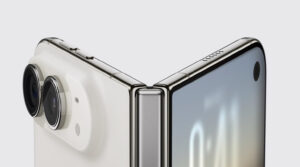
The foldable design also makes it possible to use the rear cameras for selfies, with the outer display acting as a viewfinder. The Duo Preview feature can similarly display the framing on the outer screen when photographing someone else.
The outer display also has its own 12-megapixel camera with Center Stage, capable of recording up to 4K Dolby Vision at 60 frames per second. The FaceTime camera positioned beneath the inner display can record at up to 1080p and 60 frames per second.
iOS Adapts to the Larger Display
The arrival of a 7.6-inch display also brings significant changes to the way iOS is used. The iPhone Duo will ship with iOS 27.1, whose interface automatically adapts depending on whether the device is open, closed or partially folded.
When moving from the outer display to the inner screen, the app currently in use remains open and automatically adapts to the additional screen space.
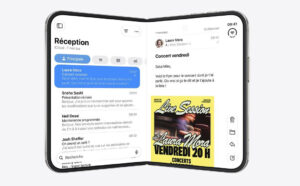
The larger display primarily makes it possible to run two apps side by side. Two windows from the same app can also be opened simultaneously, while specific app pairings can be saved for quick access later.
Apple has also repositioned some interface elements. When the iPhone Duo is open, the main controls are grouped on the right-hand side of the display, while the Dock moves to the side. Two Home Screen pages can be displayed simultaneously, with Today View widgets appearing on the left.
The Dynamic Island also switches to a vertical layout along the side of the display, where it can show Live Activities and notifications.
An iPhone That Can Stay Half-Open
The hinge allows the iPhone Duo to remain in different positions without having to be fully opened. Placed on a table in a “tent” position, for example, it can display StandBy mode and act as an alarm clock. The device can also be positioned half-open, with one section serving as the display and the other as a stand.
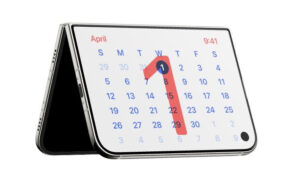
iOS automatically adapts the content to the device’s position, in both portrait and landscape orientation. In some apps, for example, the upper section can display a video while the lower section provides controls or additional content.
The iPhone Duo also features speakers positioned at the top and bottom of the chassis, with support for Spatial Audio. Several third-party apps have already been adapted to the new display format, including Slack, Zoom and Netflix. Netflix, for example, can display its browsing interface on the outer screen before automatically switching video playback to the 7.6-inch inner display when the user unfolds the iPhone Duo.

Apple Pencil Support Comes to the iPhone
Another feature made possible by the larger display is Apple Pencil support, making the iPhone Duo the first iPhone compatible with Apple’s stylus. Support for the USB-C Apple Pencil is due to be enabled later in the year and will work on both the outer and inner displays. The stylus can be used to take notes, draw, annotate documents or edit photos.
Siri AI Is Coming, but Not Immediately in Europe
The iPhone Duo supports Siri AI and the various features associated with Apple Intelligence. The assistant can use information contained in messages, emails or photos and interact with content displayed on the screen. Apple Intelligence also includes various photo-editing and image-generation tools, as well as features integrated into Safari.
However, not all of these features will be available in the European Union when the iPhone Duo launches.
Four Storage Options, Up to 2TB
Four storage capacities will be available: 256GB for €2,339, 512GB for €2,589, 1TB for €3,089 and 2TB for €3,839. Two finishes will be offered at launch: Stellar White and Midnight Sky.
The iPhone Duo will be available in France from October 23, 2026, with pre-orders opening on October 16 at 2:00 p.m.
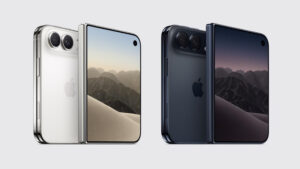
Apple will also launch several dedicated accessories alongside its first foldable iPhone, including an iPhone Duo Folio case that can double as a stand and a two-piece case designed to protect each half of the device.